It covers household handheld, commercial upright, and integrated suction and cleaning models of vacuum cleaners. These are essential cleaning devices for American households and office environments. With their advantages of efficient dust removal and convenient operation, they have become a popular export category. For the export of this product to the United States, FCC SDoC certification is the core compliance document. Unlike the行車記錄儀FCC ID which focuses on wireless radio frequency mandatory review and requires TCB certification, FCC SDoC is a self-conformity declaration by the supplier. It emphasizes a simple process and controllable costs, and mainly controls the electromagnetic compatibility of the vacuum cleaner, suitable for pure cleaning vacuum cleaners without radio frequency modules. This directly determines whether the product can be smoothly cleared customs and enter the Amazon US store.
Many foreign trade friends are engaged in the export of vacuum cleaners. They often get confused about FCC SDoC and FCC ID. Here, we will clarify them at once to avoid falling into mistakes. FCC SDoC, in full form, is the Supplier Compliance Declaration, applicable to vacuum cleaners without wireless radio frequency modules (most wired models and wireless models without intelligent linkage fall into this category). There is no need to go through TCB (Telecommunication Certification Agency) review, and there is no need to apply for a unique FCC ID mark. The enterprise can declare independently that the product complies with FCC-related standards. However, FCC ID is only for smart vacuum cleaners with wireless modules. The process is more complex and the cost is higher. These two cannot be confused and misused.
Based on the product characteristics of the vacuum cleaner, the FCC SDoC certification focuses on core control of electromagnetic compatibility. The main objective is to prevent electromagnetic interference generated during the operation of the device from affecting the normal use of domestic communication equipment in the United States. After all, the vacuum cleaner has an internal motor, and during operation, it is prone to generating electromagnetic radiation, which is also the core focus of the FCC review. The certification is adapted to the FCC Part 15B standard, and two core tests are carried out: one is the radiation emission test, which controls the electromagnetic radiation intensity of the vacuum cleaner during operation to ensure that it does not exceed the limit within the specified frequency band; the other is the conducted emission test, which checks the electromagnetic noise conducted through the power cord to avoid interfering with surrounding appliances and communication equipment.
Compared with other certifications, the processing procedure for the vacuum cleaner FCC SDoC is more streamlined and better meets the time requirements for overseas expansion of small and medium-sized export enterprises. It can be completed step by step. First, determine the type of your vacuum cleaner (wired/wireless, with/without RF module), prepare 2-3 test samples exactly the same as the production batch, and simultaneously organize the English manual, circuit schematic diagram, motor parameter table, and core component list. The manual should include the compliance warning for FCC SDoC, which is a key detail that many enterprises often overlook.
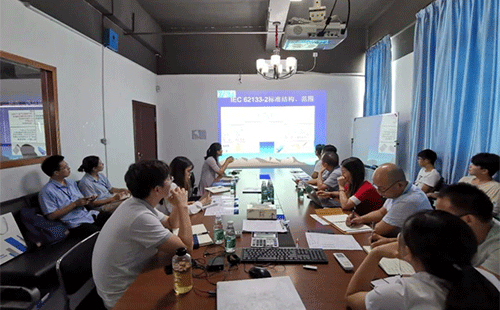
Next, a qualified third-party laboratory was entrusted to submit the samples and the complete set of materials, and initiate the comprehensive electromagnetic compatibility test. If there are issues such as excessive radiation or不合格conductive noise, the laboratory will provide targeted rectification suggestions, such as optimizing the motor layout, adding electromagnetic shielding components, and adjusting the circuit grounding design. After the rectification, the test can be re-conducted without having to go through the entire process repeatedly.
After passing the test, there is no need to submit an application to the FCC authorities. The enterprise can independently prepare and sign the FCC SDoC compliance declaration document, clearly stating the product information, test standards, test report number, responsible person, and other core contents. Then, the declaration document, test report, and product materials should be organized and archived, and retained for at least 5 years for random inspection and verification by the FCC. Finally, the compliance declaration should be marked on the product packaging or instructions, without the need to affix the FCC logo. The product can then be exported to the United States in compliance, with a regular cycle of only 1-2 weeks, and the cost is much lower than that of the FCC ID.
Here, we would like to emphasize three key points to avoid pitfalls. Please make sure to remember them: First, confirm that the product does not have a radio frequency module. If it has WiFi or Bluetooth, it must be switched to FCC ID certification; do not mistakenly use the SDoC mode. Second, the core components (motor, circuitry, and casing) of the sample and the production product must be exactly the same. Any parameter changes require re-testing and updating the declaration. Third, the importer is responsible for compliance. It is necessary to confirm that the test report provided by the manufacturer is valid and sign their own SDoC declaration. By doing these, you can efficiently complete the FCC SDoC certification and cost-effectively enter the US vacuum cleaner market.